
What Is the Best Alzheimer’s Home Care in Manhattan?
The best Alzheimer’s home care provider in Manhattan is one that offers specialized dementia training, consistent caregivers, strong supervision, and the ability to adapt care as the condition progresses. Because Alzheimer’s care requires more than basic assistance, families should focus on agencies experienced in memory care, not just general home care services.
For most families, this question does not come up early. It comes after something has already gone wrong. A loved one wanders outside and cannot find their way back. Medication is missed. A simple routine becomes confusing. Or the family caregiver reaches a point where managing everything alone is no longer realistic.
That is when the search begins. And in Manhattan, the search quickly becomes overwhelming.
There are hundreds of home care agencies in NYC. Many claim to offer dementia care. But when you look closely, most provide general senior care with limited understanding of how Alzheimer’s actually progresses in daily life.
This is where families often struggle. The difference between general home care and true Alzheimer’s care is not small. It directly impacts safety, emotional stability, and long-term outcomes.
The scale of the issue also explains why choosing carefully matters. In the United States, more than 6.9 million adults aged 65 and older are living with Alzheimer’s, and the number continues to grow each year.
In real-world settings like Manhattan, the risks are practical, not theoretical. Patients may wander, forget routines, or misjudge familiar environments. For families, this often turns into constant supervision, stress, and eventually burnout if proper support is not in place.
This is why choosing the right home care provider is not just about convenience. It is about reducing risk, maintaining stability, and supporting both the patient and the family over time.
This guide breaks that difference down clearly. It also gives you a structured way to evaluate providers, along with a list of the top Alzheimer’s and dementia home care agencies in Manhattan based on what actually matters in real-world care.
How We Evaluated the Top Alzheimer’s Home Care Providers
Choosing dementia home care is not about finding the most popular agency. It is about finding one that can handle a condition that changes over time, often unpredictably.
To build this list, we focused on criteria that directly affect the quality of day-to-day care and long-term stability.
Dementia-Specific Training
Alzheimer’s is not just memory loss. It affects behavior, mood, communication, and decision-making. Caregivers must understand how to respond when a patient becomes confused, anxious, or resistant. Without training, these situations escalate quickly.
Caregiver Consistency
One of the most overlooked factors in dementia care is familiarity. Patients rely heavily on routine and recognition. When caregivers change frequently, confusion increases. Anxiety increases. Trust breaks down.
Consistency is not a luxury in Alzheimer’s care. It is essential.
Supervision and Oversight
Strong agencies do not just assign a caregiver and step back. They monitor performance, adjust care plans, and stay involved. This matters more as the condition progresses.
Ability to Handle Behavioral Changes
Wandering, agitation, sleep disruption, and mood swings are common in dementia. These are not occasional issues. They are daily realities. Caregivers must know how to manage them calmly and safely.
Flexibility of Care Plans
Alzheimer’s does not stay the same. Early-stage care looks very different from late-stage care. The right provider adjusts support as needs increase, rather than forcing families to restart the process later.
Experience in Manhattan
Providing care in Manhattan comes with unique challenges. Apartment living, limited space, elevator access, building rules, and transportation all affect how care is delivered.
Reputation and Reliability
Reviews matter, but consistency matters more. Families need agencies that show up, communicate clearly, and maintain quality over time.
Top 7 Alzheimer’s & Dementia Home Care Providers in Manhattan
#1 All Heart Home Care Agency — Best Overall for Dementia Home Care
All Heart Home Care Agency ranks first because it approaches Alzheimer’s care as a long-term, evolving process rather than a checklist of tasks.
Most agencies can assist with daily activities. Fewer understand how those needs change month by month as dementia progresses.
What their care typically includes:
- Structured care plans based on disease stage
- Caregivers trained specifically in Alzheimer’s and dementia care
- Consistent caregiver assignment to reduce confusion
- Ongoing communication with families
- Support for both patient and caregiver stress
Why it stands out in real-world use:
In early stages, support may focus on reminders and supervision. As the condition progresses, the same patient may require behavioral management, safety monitoring, and eventually full-time care.
Agencies that do not plan for this transition often create instability later. All Heart Home Care Agency builds care plans around this progression from the start, offering structured home health care and private pay home care services that adapt as patient needs evolve.
Agencies that do not plan for this transition create instability later. All Heart builds care around that progression from the start.
#2 Alliance Homecare — Best for High-Touch Personalized Care
Alliance Homecare operates at the premium end of the market. Their focus is on customization and close supervision.
Where they perform well:
- Caregiver selection and matching
- Strong internal oversight
- Personalized care structure
Where families should evaluate carefully:
- Cost is significantly higher than average
- Not always necessary for moderate care needs
This option works best for families who want a highly managed, concierge-style care experience.
#3 Partners in Care — Best for Cost-Conscious Care
Partners in Care offers a more accessible entry point into home care services.
Strengths:
- Large caregiver network
- Flexible scheduling
- Lower cost options
Limitations in dementia care:
While they provide support, their structure is not always built around advanced Alzheimer’s needs. Families may need to be more involved in managing care progression.aQa
#4 Edison Home Health Care — Best for Medicaid-Based Care
Edison is widely used by families working within Medicaid coverage.
Strengths:
- Medicaid-friendly programs
- Multilingual caregivers
- High availability
Consideration:
Because of its scale, care can feel less personalized. This becomes more noticeable in later stages of dementia.
#5 Amada Senior Care — Best for Insurance Navigation
Amada Senior Care is known for helping families manage the financial side of long-term care.
Where they add value:
- Assistance with long-term care insurance
- Structured care coordination
- Guidance for families new to home care
This is especially useful for families who are unsure how to fund ongoing Alzheimer’s care.
#6 Visiting Angels — Best for Flexible Scheduling
Visiting Angels provides broad coverage and flexible care hours.
Strengths:
- Adjustable schedules
- Established brand recognition
- Wide caregiver availability
Limitations:
- Service quality can vary by location
- Less specialized dementia focus compared to top-tier providers
#7 Right at Home — Best for Structured Systems
Right at Home offers a more standardized approach to care.
Strengths:
- Consistent processes
- Structured care plans
- Reliable operations
This works well for families who prefer predictability over customization.
What Makes Alzheimer’s Home Care Different from Regular Home Care
This is where many families misunderstand what they actually need.
On the surface, home care may look similar. A caregiver helps with meals, hygiene, mobility, and daily routines. But Alzheimer’s care is not just about completing tasks. It is about understanding how the patient experiences those tasks.
General home care focuses on physical support. Alzheimer’s and dementia care focuses on behavior, cognition, and emotional stability.
A patient with dementia does not just forget things. They may:
- Forget where they are, even in their own home
- Misinterpret situations or people
- Become anxious, agitated, or defensive without a clear reason
- Resist help, even when they need it
In these moments, the caregiver’s response matters more than the task itself.
Without proper training, a caregiver may correct the patient, argue, or try to force cooperation. This often makes the situation worse. Confusion increases. Anxiety increases. Trust breaks down.
A trained Alzheimer’s caregiver approaches the same situation differently.
Instead of correcting, they redirect.
Instead of arguing, they reassure.
Instead of rushing, they stabilize the routine.
Alzheimer’s home care typically includes:
- Behavioral redirection to manage confusion without escalation
- Emotional reassurance to reduce anxiety and fear
- Routine stabilization to create predictability in daily life
- Continuous safety monitoring to prevent wandering or accidents
Over time, these small differences create a major impact. Patients feel more secure. Episodes of agitation decrease. Daily life becomes more manageable for both the patient and the family.
For families trying to understand the condition itself, including how symptoms differ and when care becomes necessary, you can explore this detailed guide on dementia vs Alzheimer’s symptoms and care.
Alzheimer’s care is not just about helping someone live at home. It is about helping them feel safe, understood, and stable in a world that is gradually becoming more confusing.
Signs Your Loved One Needs Dementia Home Care
Families often wait until the situation becomes urgent. In most cases, the signs appear gradually.
Common indicators include:
- Getting lost in familiar places
- Repeating the same questions multiple times
- Missing or mismanaging medication
- Leaving appliances on
- Increased confusion during the evening
- Physical safety risks at home
- Caregiver exhaustion
When these signs become consistent, support is no longer optional. It becomes necessary to maintain safety.
Cost of Alzheimer’s Home Care in Manhattan
The cost of dementia home care reflects the level of supervision and specialization required.
Typical Cost Breakdown
Care Type | Monthly Cost Range | What It Includes |
Hourly Care | $30 – $40 per hour | Basic supervision, assistance with daily tasks |
Part-Time Care | $3,000 – $6,000 | 4–6 hours daily support, medication reminders, companionship |
Full-Time Care | $8,000 – $15,000 | 8–12 hours daily care, routine monitoring, behavioral support |
24-Hour Care | $15,000 – $25,000+ | Continuous supervision, safety monitoring, and advanced dementia care |
Costs increase as care becomes more intensive, particularly when overnight supervision is required.
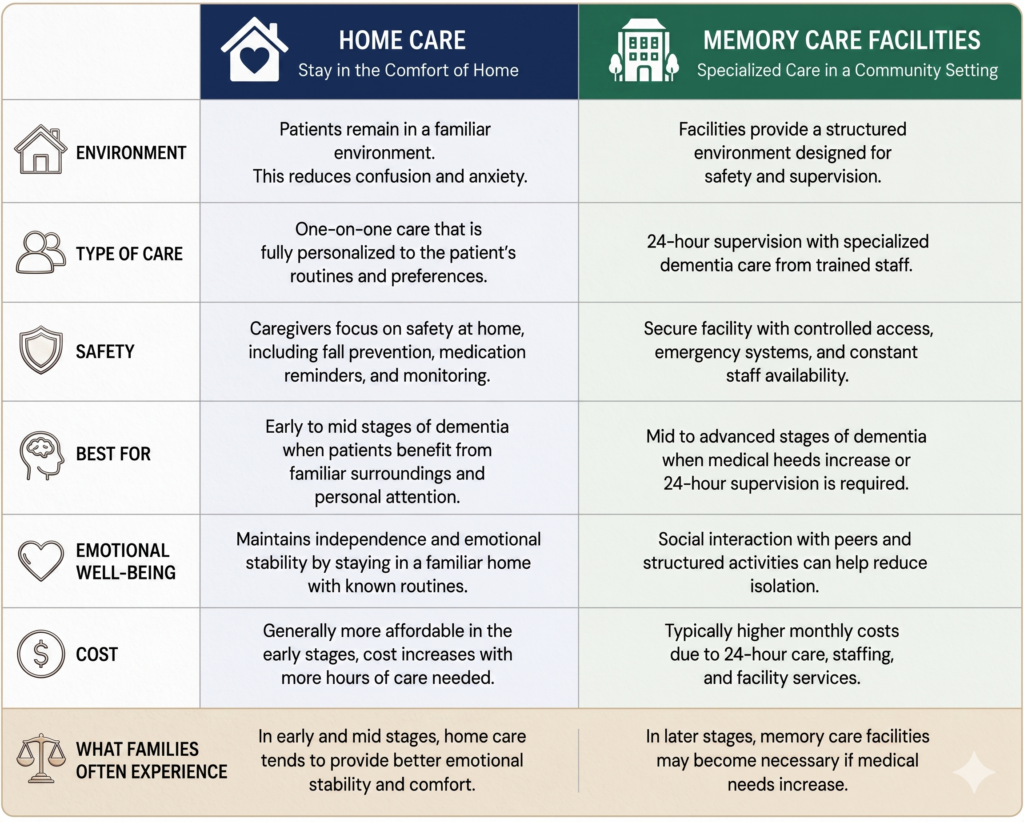
Home Care vs Memory Care Facilities in NYC
This is one of the most important decisions families face.
How to Choose the Right Dementia Home Care Provider
The right provider is not always the most well-known one. It is the one who understands your situation in detail.
Questions to Ask
- What dementia training do caregivers receive?
- Will the same caregiver remain assigned?
- How do you handle agitation or confusion?
- How often are care plans updated?
- Who supervises the caregiver?
What to Avoid
- Generic care models
- High caregiver turnover
- Lack of communication
- One-size-fits-all plans
What to Pay Attention To
The initial consultation is often the clearest signal. A strong agency will ask detailed questions about behavior, routines, and risks. A weak one will focus only on hours and pricing.
Why Families Choose Home Care for Alzheimer’s in Manhattan
The decision often comes down to stability.
At home:
- The environment is familiar
- Daily routines remain intact
- Anxiety is reduced
- Care is individualized
For many Manhattan families, this leads to better day-to-day outcomes, especially in earlier stages.
How All Heart Home Care Supports Alzheimer’s & Dementia Care in Manhattan
Alzheimer’s care at home is not just about assistance. It is about maintaining stability in a situation that becomes increasingly unpredictable over time. Daily routines, medication adherence, behavioral changes, and safety risks all need consistent attention — and managing all of this alone is often not realistic for families.
All Heart Home Care Agency is built for this level of care. Their approach focuses on long-term dementia support, not short-term task-based assistance. Caregivers are trained to handle memory loss, confusion, and behavioral challenges while maintaining a calm and structured environment at home.
From early-stage supervision to advanced 24-hour care, their services adapt as the condition progresses. This includes consistent caregiver assignments, ongoing communication with families, and care plans designed around real daily routines rather than generic templates.
For families who need more advanced medical support, All Heart also provides private duty nursing options in NYC, allowing care to remain at home even as needs become more complex.
All services are available through Medicaid or private-pay arrangements, giving families flexible options based on their situation.
Contact us today for a free consultation and speak with a care advisor to understand the right level of support for your loved one.
What Makes Alzheimer’s Home Care Different from Regular Home Care
This is where many families misunderstand what they actually need.
On the surface, home care may look similar. A caregiver helps with meals, hygiene, mobility, and daily routines. But Alzheimer’s care is not just about completing tasks. It is about understanding how the patient experiences those tasks.
General home care focuses on physical support. Alzheimer’s and dementia care focuses on behavior, cognition, and emotional stability.
A patient with dementia does not just forget things. They may:
- Forget where they are, even in their own home
- Misinterpret situations or people
- Become anxious, agitated, or defensive without a clear reason
- Resist help, even when they need it
In these moments, the caregiver’s response matters more than the task itself.
Without proper training, a caregiver may correct the patient, argue, or try to force cooperation. This often makes the situation worse. Confusion increases. Anxiety increases. Trust breaks down.
A trained Alzheimer’s caregiver approaches the same situation differently.
Instead of correcting, they redirect.
Instead of arguing, they reassure.
Instead of rushing, they stabilize the routine.
Alzheimer’s home care typically includes:
- Behavioral redirection to manage confusion without escalation
- Emotional reassurance to reduce anxiety and fear
- Routine stabilization to create predictability in daily life
- Continuous safety monitoring to prevent wandering or accidents
Over time, these small differences create a major impact. Patients feel more secure. Episodes of agitation decrease. Daily life becomes more manageable for both the patient and the family.
For families trying to understand the condition itself, including how symptoms differ and when care becomes necessary, you can explore this detailed guide on dementia vs Alzheimer’s symptoms and care.
Alzheimer’s care is not just about helping someone live at home. It is about helping them feel safe, understood, and stable in a world that is gradually becoming more confusing.
Signs Your Loved One Needs Dementia Home Care
Families often wait until the situation becomes urgent. In most cases, the signs appear gradually.
Common indicators include:
- Getting lost in familiar places
- Repeating the same questions multiple times
- Missing or mismanaging medication
- Leaving appliances on
- Increased confusion during the evening
- Physical safety risks at home
- Caregiver exhaustion
When these signs become consistent, support is no longer optional. It becomes necessary to maintain safety.
Cost of Alzheimer’s Home Care in Manhattan
The cost of dementia home care reflects the level of supervision and specialization required.
Typical Cost Breakdown
Care Type | Monthly Cost Range | What It Includes |
Hourly Care | $30 – $40 per hour | Basic supervision, assistance with daily tasks |
Part-Time Care | $3,000 – $6,000 | 4–6 hours daily support, medication reminders, companionship |
Full-Time Care | $8,000 – $15,000 | 8–12 hours daily care, routine monitoring, behavioral support |
24-Hour Care | $15,000 – $25,000+ | Continuous supervision, safety monitoring, and advanced dementia care |
Costs increase as care becomes more intensive, particularly when overnight supervision is required.
FAQ
What is the best dementia home care in Manhattan?
The best dementia home care provider is one that offers trained caregivers, consistent assignments, and care plans that adapt as Alzheimer’s progresses. Agencies with real experience in memory care, such as All Heart Home Care Agency, are often preferred because they focus on long-term care, not just daily assistance. It is also important to choose a provider that offers specialized services like home health care, private pay home care, and dedicated Alzheimer’s and dementia care to ensure complete support at every stage.
How much does Alzheimer’s home care cost in Manhattan?
Alzheimer’s home care typically ranges from $25 to $40 per hour. Monthly costs can vary from $3,000 for part-time care to over $20,000 for 24-hour support, depending on the level of supervision required.
When should someone with dementia start home care?
Home care should begin when safety risks, confusion, or difficulty managing daily tasks start affecting everyday life. Waiting too long often leads to emergencies that could have been prevented with early support.
Is dementia home care better than a nursing home or facility?
For early and mid-stage Alzheimer’s, home care is often preferred because it allows patients to stay in a familiar environment. This reduces confusion and stress. Facilities may become necessary at advanced stages when 24/7 medical supervision is required.
What services are included in Alzheimer’s home care?
Dementia home care typically includes medication reminders, personal care, meal preparation, safety monitoring, behavioral support, and companionship. In more advanced cases, it may also include 24-hour supervision and mobility assistance.
Do caregivers need special training for Alzheimer’s care?
Yes. Alzheimer’s care requires specific training to handle memory loss, behavioral changes, and communication challenges. Caregivers without this training may struggle to safely manage situations such as agitation, wandering, or confusion.
Can Alzheimer’s patients stay at home safely?
Yes, with the right level of supervision. Home care can significantly improve safety by providing constant monitoring, reducing fall risks, and preventing wandering. The level of care should match the stage of the condition.
How many hours of care does a dementia patient need?
This depends on the stage of Alzheimer’s. Early-stage patients may need only a few hours per day, while mid to late-stage patients often require full-time or 24-hour care to ensure safety and stability.

Tatiana is the Strategy Director at All Heart Homecare Agency, an award-winning New York home care provider. Drawing on five years in the home care market, she brings a firsthand understanding of what patients and caregivers need. Her writing reflects direct work within one of New York's active HHA agencies.