
Most families searching for private-pay home care are already in a stressful situation. A loved one has lost some independence, a hospital discharge is coming faster than expected, or the gap between what someone can do on their own and what they need has quietly grown too wide to ignore. The question “who can actually help us, and what will it cost?” deserves a clear, direct answer, not a wall of confusing comparisons.
Private pay non-medical home care means paying out of pocket for a trained caregiver who helps with activities of daily living: bathing, grooming, meal preparation, light cleaning, transportation to appointments, and companionship. No physician’s order is required, and no insurance company decides what your loved one can or cannot receive. That flexibility is exactly why families choose it.
Industry research shows private pay continues to lead revenue growth opportunities, with 68% of home care agencies identifying it as their greatest growth channel, up from 61% the year prior.
This guide breaks down the top non-medical home care companies available for private pay, what to look for when comparing them, and what questions to ask before committing.
Key takeaways
- Non-medical home care covers daily living support, such as meal prep, bathing assistance, light housekeeping, and transportation, without requiring a physician’s order or insurance approval.
- Private pay plans let families build fully customized schedules with no insurer restrictions, but cost and agency quality vary significantly by location and provider.
- The best private pay agencies are evaluated on caregiver screening standards, service flexibility, multilingual staff, specialty program availability, and transparent pricing.
- National franchise brands offer wide name recognition, but local NYC agencies often provide deeper familiarity with borough-specific programs, Medicaid transitions, and culturally sensitive care.
- Asking the right questions before signing with any agency, including caregiver background check processes and backup caregiver policies, is what separates a good experience from a poor one.
How To Evaluate Private Pay Home Care Companies
There is no single national standard that governs how private pay home care agencies screen caregivers, structure plans, or handle emergencies. That makes the evaluation process one of the most important steps a family can take. The companies that earn a spot on any credible “best of” list share certain qualities across a few non-negotiable categories.
Caregiver Screening and Training
The person entering your loved one’s home every day is the actual product being delivered. Ask every agency you speak with exactly how they screen their staff. A reputable agency will confirm criminal background checks, reference verification, and identity validation as standard.
Certified Home Health Aides (CHHAs) have completed state-approved training programs and passed competency evaluations, which represent a meaningful quality floor above that of an untrained personal care aide.
Agencies that conduct ongoing competency assessments, not just onboarding checks, demonstrate a higher standard of quality control.
Schedule Flexibility and Minimum Hours
Some agencies require a minimum of four hours per visit, which may not fit a family needing two-hour morning support visits five days a week. Others are genuinely flexible. Private pay plans should be customizable around the actual rhythm of a client’s day, not around the agency’s staffing convenience.
Ask specifically whether plans can scale up during a health event and scale back afterward, and whether live-in or 24/7 arrangements are available for clients with higher needs.
Backup Caregiver Policies
One of the most common failures in home care occurs when the regular caregiver calls in sick. A strong agency has a bench of qualified backup caregivers and a clear internal protocol for same-day coverage. A weak agency leaves the family scrambling. This question is often overlooked in the initial conversation and should always be asked directly.
Specialty Program Availability
Private pay clients are not a monolithic group. A senior with Alzheimer’s has different needs than a TBI patient or an elderly person who only speaks Russian. The best agencies for private pay non-medical home care for seniors have dedicated programs for dementia and memory care, and many of the strongest local providers in New York City offer additional specializations that national franchise brands simply cannot match.
Transparent Pricing and no Hidden Fees
Any legitimate private pay agency should be able to tell you their hourly rate, their minimum hours per shift, their holiday pricing policies, and any administrative fees during your first consultation. Vague pricing, bundled packages without itemization, or pressure to sign before reviewing a contract are red flags.
What Non-Medical Home Care For Seniors Includes
Non-medical home care is often confused with home health care, and the difference matters for both billing and service expectations. Home health care is skilled, medically supervised care, typically prescribed by a doctor and billed through Medicare or insurance. It involves licensed nurses, physical therapists, and certified aides operating within a clinical care plan.
Families who want a clearer picture of what to budget can review our private pay home care rates guide and how plans are priced across different service levels in NYC.
Non-medical home care, sometimes called personal care or companion care, sits in a different category entirely. It focuses on the activities of daily living that keep someone safe, comfortable, and functioning at home.
Core Services Covered Under Non-Medical Care
Services typically included in a private pay non-medical plan:
- Personal care: bathing, dressing, grooming, oral hygiene, and incontinence assistance
- Mobility support: transfers, walking assistance, fall prevention, and positioning
- Meal preparation: cooking, dietary accommodations, feeding assistance
- Homemaking: light housekeeping, laundry, dishwashing, grocery shopping
- Companionship: conversation, engagement in activities, and social connection
- Transportation: escorted trips to medical appointments, errands, and community outings
- Medication reminders: prompting a client to take medication on schedule (not administering)
What non-medical caregivers cannot do is perform clinical tasks such as wound care, injections, or anything requiring a nursing license. Families who need that level of support alongside personal care need a provider that offers both, or a blended care plan that coordinates the two.
Why Private Pay is Different From Insurance-Based Care
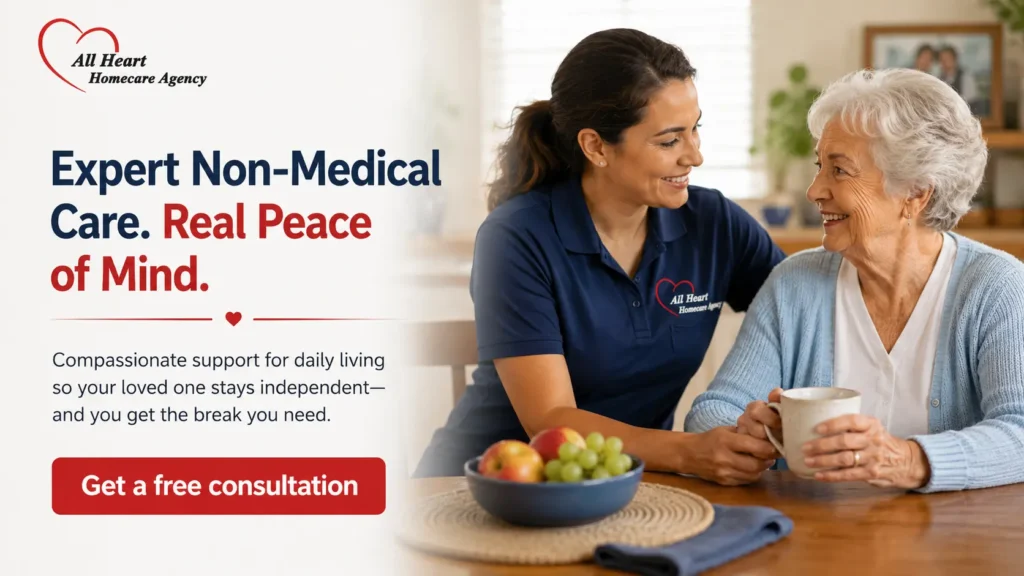
When home care is paid through Medicaid or Medicare, the insurer dictates the number of hours, the type of tasks covered, and often the specific aide assigned. Private pay removes that layer entirely. You negotiate directly with the agency, set the schedule based on actual need, and adjust as things change. Families commonly use private pay to cover gaps not covered by insurance, access more hours than insurance allows, or bring in a specific type of caregiver with a particular language or specialty skill.
The tradeoff is cost. According to the 2025 CareScout Cost of Care Survey, the national median hourly rate for non-medical caregiver services reached $35 per hour, a 3% increase year-over-year. In high-cost metro areas like New York City, rates regularly run higher. Families should treat that national figure as a floor, not a ceiling.
6 Top Private Pay Non-Medical Home Care Companies
The companies below are evaluated based on service range, caregiver standards, geographic reach, specialty care capabilities, and the overall value proposition for private-pay clients.
This is not a ranking based on marketing spend or name recognition.
| Provider | Founded | Core Services | Specialty Programs | Areas Served | Best For |
| All Heart Homecare | Brooklyn, NY, 13+ yrs ago | Personal care, companion, 24/7, nursing | TBI, Alzheimer’s, NHTD, Veterans, Holocaust Program | All 5 NYC boroughs | NYC families needing local expertise and NYC-specific programs |
| Visiting Angels | Haverford, PA, 1998 | Personal care, companion, respite, memory care | Memory care, end-of-life | 49 states | Suburban/rural families seeking a national franchise |
| Home Instead | Omaha, NE, 1994 | Companion, personal care, hospice support | Alzheimer’s, dementia, hospice | ~1,200 locations worldwide | Families prioritizing structured caregiver training |
| Comfort Keepers | Springfield, OH, 1998 | Personal care, companion, safety monitoring | Alzheimer’s, end-of-life, transitional care | 700+ franchises, 12 countries | Clients needing an engagement-focused care model |
| Senior Helpers | Baltimore, MD, 2001 | Personal care, companion, respite | Parkinson’s, Alzheimer’s, Senior Gems program | 45+ states | Families managing Parkinson’s or progressive dementia |
| Right at Home | Omaha, NE, 1995 | Companion, personal care, disability support | Memory care, post-hospital transitional care | US and international | Clients who want a structured, documented care framework |
1. All Heart Homecare Agency
All Heart Homecare Agency was founded in Brooklyn, New York, and has operated within New York City for over 13 years. The agency runs two offices, one in Brooklyn and one in Manhattan, and serves clients across all five boroughs. It is Better Business Bureau accredited, holds the #1-ranked home care agency position in Brooklyn, and has built a track record of more than 1,000 clients and 500-plus verified positive reviews. The company’s operating philosophy, “care for one as you would care for your loved one,” reflects a family-owned model built around long-term relationships rather than high-volume placement.
Core services covered: Personal care, companion care, meal preparation, grooming and hygiene assistance, light housekeeping, transportation to medical appointments, and around-the-clock continuous care for high-need clients. All caregivers are Certified Home Health Aides (CHHAs), fully insured, and matched to clients based on language preference in English, Spanish, and Russian.
Specialty programs: Alzheimer’s and dementia care, Traumatic Brain Injury (TBI) care, the NHTD (Nursing Home Transition and Diversion) program, Veterans home health care through the VetAssist program, a Holocaust survivor program with culturally sensitive care in Brooklyn, workers’ compensation home care, pediatric and adult private duty nursing, and Medicaid-covered home care.
Areas served: We serve home care in Brooklyn, Manhattan, Queens, the Bronx, and Staten Island.
Best for: NYC families who need a locally rooted agency with deep knowledge of New York State programs, multilingual caregiver matching, specialty care programs, and a private pay plan that can transition to Medicaid or veteran benefits as circumstances change
Limitation: Service is exclusive to the five NYC boroughs; families outside New York City would need a different provider
Private pay pricing: Customizable plans based on hours and care level; free consultation available
2. Visiting Angels
Visiting Angels was founded in 1998 in Haverford, Pennsylvania, by Jeffrey Johnson, with the goal of helping seniors age in place comfortably in their own homes. The company grew into one of the largest non-medical home care franchise networks in the country, operating through more than 600 agencies across 49 states. It is a privately owned franchise company and has been a consistent presence in the senior care space for over 25 years.
Core services covered: Personal care, bathing and grooming assistance, meal preparation, light housekeeping, companionship, mobility support, and respite care for family caregivers. The company also offers a HIPAA-compliant smart speaker product called Constant Companion for clients who want remote monitoring between caregiver visits.
Specialty programs: Memory care for clients with Alzheimer’s and dementia, end-of-life companion care, and fall-prevention services. Specialty depth varies by individual franchise location.
Areas served: 49 US states; local coverage depends on the franchise’s proximity to the client’s address.
Best for: Families in suburban or rural areas where a nationally recognized franchise fills a gap, particularly those who value free in-home consultations and flexible scheduling without long-term contracts
Limitation: As a franchise model, service quality and specialty program depth vary significantly between individual locations; NYC-specific programs like CDPAP and NHTD are not part of the standard offering
Private pay pricing: Hourly rates are location-specific and provided after a free in-home consultation
3. Home Instead
Home Instead was founded in 1994 in Omaha, Nebraska, by Paul and Lori Hogan after they experienced firsthand the challenge of finding quality care for an aging family member. The company pioneered the non-medical senior care franchise model and has grown to nearly 1,200 locations worldwide. In August 2021, Home Instead was acquired by Honor, a technology-driven care platform, which introduced a new layer of caregiver-matching and workforce-management tools to the franchise network.
Core services covered: Companion care, personal care, meal preparation, medication reminders, light housekeeping, transportation, and hospice support services. Their CAREGiver training program includes specialized coursework for dementia and Alzheimer’s care that goes beyond standard ADL training.
Specialty programs: Alzheimer’s and dementia care, hospice family support, and post-hospital transitional care. The Honor platform integration has expanded caregiver scheduling tools at some locations.
Areas served: Available in most major US metros and internationally; service availability in specific NYC boroughs depends on individual franchise territories.
Best for: Families who prioritize a structured caregiver training program and want access to one of the largest global home care networks
Limitation: The Honor acquisition has shifted some operations toward a tech-mediated staffing model, which families looking for a more personal, relationship-driven agency sometimes find impersonal; NYC-specific program navigation is not a core competency
Private pay pricing: Rates vary by franchise location and are quoted after an initial care consultation
4. Comfort Keepers
Comfort Keepers was founded in 1998 in Springfield, Ohio, by Kris Butler, a nurse who wanted to bring a more interactive and engaged model to non-medical home care. The company was later acquired by Halifax, a UK-based health and social care company, and has since grown to more than 700 independently-owned franchises across 12 countries. The brand’s defining philosophy is “Interactive Caregiving,” which positions caregivers as active participants in a client’s daily life rather than passive task-completers.
Core services covered: Personal care, companion care, light housekeeping, meal preparation, medication reminders, safety monitoring, and in some locations, skilled private-duty nursing services. All caregivers are fully bonded, insured, and subject to criminal background checks.
Specialty programs: Dementia and Alzheimer’s care through their Alzheimer’s & Dementia Care specialty program, end-of-life care support, and transitional care following hospitalization. Program availability varies by franchise.
Areas served: 45-plus states in the US and locations across Canada, Australia, Portugal, and several other countries.
- Best for: Clients at risk of social isolation who respond well to an engagement-focused caregiving model, and families who want bonded and insured caregivers with a consistent brand standard
- Limitation: Consumer review consistency is mixed across franchises; NYC-specific program depth for Medicaid, CDPAP, or NHTD is not part of the standard offering
- Private pay pricing: Rates are quoted after an in-home assessment and tend to fall near national averages
5. Senior Helpers
Senior Helpers was founded in 2001 in Baltimore, Maryland, by Tony Bonacuse and Peter Ross after they encountered difficulty finding specialized care for their aging parents. The company grew into a franchise network now operating in 45-plus states, with a particular emphasis on care for clients managing specific diagnoses rather than general companion or personal care needs.
Core services covered: Personal care, companion care, respite care, medication reminders, meal preparation, and light housekeeping. Their LIFE Profile assessment tool evaluates a client’s cognitive and physical ability to match the appropriate level of care from day one.
Specialty programs: Alzheimer’s and dementia care developed in partnership with the Alzheimer’s Association; a dedicated Parkinson’s care program; and a Senior Gems program that addresses different stages of cognitive decline with tailored caregiver responses. Parkinson’s care is one of the most differentiated specialty offerings among national franchise brands in this comparison.
Areas served: 45-plus states; not available in all major metro markets at the same location density as larger competitors.
- Best for: Families managing a specific diagnosis like Parkinson’s or mid-to-late-stage Alzheimer’s who want a structured, disease-specific care program with ongoing caregiver training tied to that condition
- Limitation: Coverage gaps exist in some metro areas; NYC-specific program knowledge and Medicaid transition support fall outside the company’s standard service model
- Private pay pricing: Rates vary by location and are provided after the LIFE Profile assessment
6. Right at Home
Right at Home was founded in 1995 in Omaha, Nebraska, by Allen Hager, a hospital administrator who saw a recurring gap between what seniors needed at home after discharge and what was available to them. The company operates as a franchise model with locations across the US, UK, Australia, and several other countries, serving seniors and adults with disabilities who want to maintain independence at home.
Core services covered: Companion care, personal care, meal preparation, light housekeeping, transportation, medication reminders, and dementia-specific support. Their Independent Living Assistance model organizes care around five domains: mobility, personal hygiene, nutrition, safety, and mental well-being.
Specialty programs: Memory care training through their dementia coursework, post-hospital transitional care, and disability support services for adults with physical or cognitive limitations.
Areas served: Available across the US and several international markets; NYC coverage depends on franchise territory assignments.
- Best for: Clients who want a care plan built around a documented, structured framework with regular reviews and clear accountability between caregiver visits
- Limitation: NYC-specific program depth for NHTD, CDPAP, or Medicaid transition is limited; the franchise model means local quality depends heavily on individual ownership and management
- Private pay pricing: Rates are quoted locally after an initial care consultation
Questions To Ask Any Home Care Agency Before Signing
Most home care agencies make similar claims on their websites. The questions below cut through the surface and get to the operational reality of how a specific agency works.
- What is your process if my regular caregiver is unavailable?
- Are caregivers employees or independent contractors, and how does that affect liability?
- What does your background check process include, and how recently were checks completed?
- Can I choose or switch my caregiver if the match isn’t right?
- Do you have experience with [specific condition], and can you walk me through what care looks like for that diagnosis?
- What is your minimum number of hours per visit, and can the plan scale up or down without a contract change?
- How are care plans documented and reviewed, and who is my point of contact if concerns arise?
- What specific NYC programs do you work with, and can you help navigate Medicaid eligibility if my situation changes?
Agencies that answer these questions confidently, with specifics rather than generalities, have a real operational infrastructure behind their marketing. Agencies that deflect, reframe, or give vague answers to basic operational questions deserve scrutiny before any commitment is made
Why All Heart Care is the Right Choice for Non-Medical In-Home Care For Seniors in NYC
Choosing a private pay home care provider in New York City is not the same as choosing one in a smaller market. The regulatory environment, the availability of borough-specific programs, the multilingual care requirements, and the sheer density of options all make the evaluation process harder than it looks. National brands can fill a gap in many markets, but they were not built around CDPAP, NHTD, New York Medicaid transitions, or the specific communities that make up Brooklyn and the broader five boroughs.
All Heart Homecare Agency has been doing this work in those exact communities for over 13 years. Their private pay program gives families complete flexibility to build a plan without insurance restrictions, while keeping the door open to transitioning to Medicaid, veterans’ benefits, or other NYC-specific programs as circumstances evolve.
The 24/7 on-call support, free medical transportation, bilingual caregiver matching, and specialty programs like TBI and Alzheimer’s care are not add-ons. They are built into how the agency operates.
For families navigating this decision right now, the best first step is a conversation.
Contact us today for a free consultation, and let All Heart build a private-pay care plan tailored to what your loved one actually needs.
Frequently asked questions about non-medical home care for private pay
What is the difference between non-medical home care and home health care?
Non-medical home care covers assistance with activities of daily living, such as bathing, dressing, meal preparation, and companionship. Home health care is medically supervised, prescribed by a doctor, and delivered by licensed nurses or therapists. Non-medical care does not require a physician’s order and is typically paid out of pocket or through long-term care insurance, whereas home health care is often billed through Medicare or Medicaid.
Does Medicare cover non-medical home care for seniors?
Medicare does not cover ongoing non-medical home care. Medicare Part A may cover short-term skilled home health services following a hospitalization, but coverage is time-limited and tied to a medical-necessity determination. Families needing consistent personal care or companion services must either pay out of pocket or explore Medicaid eligibility, long-term care insurance, or VA benefits, if applicable.
How do I know if a private pay home care agency in NYC is reputable?
Look for BBB accreditation, state licensure from the New York State Department of Health, verified consumer reviews across multiple platforms, and clear answers to operational questions, such as caregiver screening practices and backup caregiver policies. Agencies with more than a decade of documented service history in New York City and a portfolio of specialty programs typically represent a higher standard than newer or purely franchise-based operators.
Can private pay home care transition to Medicaid-covered care later?
Yes, in many cases. If a client’s financial and clinical situation changes and they meet New York Medicaid eligibility criteria, a qualified agency can often facilitate that transition and continue providing care under the Medicaid program. This is one of the key reasons why working with a local NYC agency familiar with both private pay and Medicaid-funded programs is advantageous from the start.
What is CDPAP, and how does it relate to private pay home care?
CDPAP, the Consumer Directed Personal Assistance Program, is a New York State Medicaid program that allows eligible individuals to choose their own caregivers, including family members and close friends, who are then compensated through the program. For families currently using private pay for a family member to provide care, CDPAP can convert that informal arrangement into a formal paid arrangement, significantly reducing out-of-pocket costs. An experienced NYC home care agency can help determine eligibility and facilitate enrollment.
What should a private pay home care plan include at a minimum?
A well-structured plan should specify scheduled visit days and times, the tasks the caregiver is responsible for, emergency contact protocols, a process for updating the plan as needs change, caregiver assignment and substitution policies, and clear pricing with no undisclosed fees. A written care agreement protects both the family and the agency and should be reviewed before any care begins.
Is private pay home care in NYC more expensive than in other cities?
Yes, generally. New York City’s higher cost of living and caregiver wage requirements push rates above the national median of $35/hour. NYC families should budget for rates typically in the $30–$45/hour range for standard personal care, with specialized care for dementia, TBI, or complex medical needs running higher. That said, per-hour cost should always be weighed against caregiver quality, access to specialty programs, and the agency’s actual operational depth in the boroughs where care is needed.