

The main difference: private pay home care delivers one-on-one help in your loved one’s own home and is usually more affordable for part-time care, while assisted living bundles housing and round-the-clock support into one monthly fee and can become more cost-effective for high-hour, 24/7 needs. In short, home care lets someone stay where they are; assisted living moves them into a community.
Choosing between them is one of the biggest decisions a family makes. This 2026 comparison breaks down the real costs, the trade-offs, and why, for most seniors who want to stay in their own home, private pay home care is the choice families are most glad they made.
For the skilled-care angle, see our related guide, Home Health Care vs. Assisted Living.
Key Takeaways
- Private pay home care brings one-on-one help to your loved one’s own home, billed hourly; you pay only for the hours you need.
- Assisted living bundles housing, meals, and basic care with 24/7 on-site staff into one monthly fee, in a community setting.
- For part-time care, home care is usually cheaper; for round-the-clock needs, assisted living can become more cost-effective.
- Typical 2026 costs: home care ~$32–$35/hour (about $6,600/month for 44 hrs/week); assisted living a national median of ~$5,800–$6,200/month.
- Home care keeps a loved one at home: familiar surroundings, one-on-one attention, and their own routine.
- Medicare pays for neither long-term care nor home care; private pay, long-term care insurance, or Medicaid funds home care.
Private Pay Home Care vs. Assisted Living: The Core Difference
The fundamental difference is where care happens. With home care, a caregiver comes to your loved one’s home and provides one-on-one support. With assisted living, your loved one moves into a residential community where housing, meals, and care are bundled together with staff on-site around the clock.
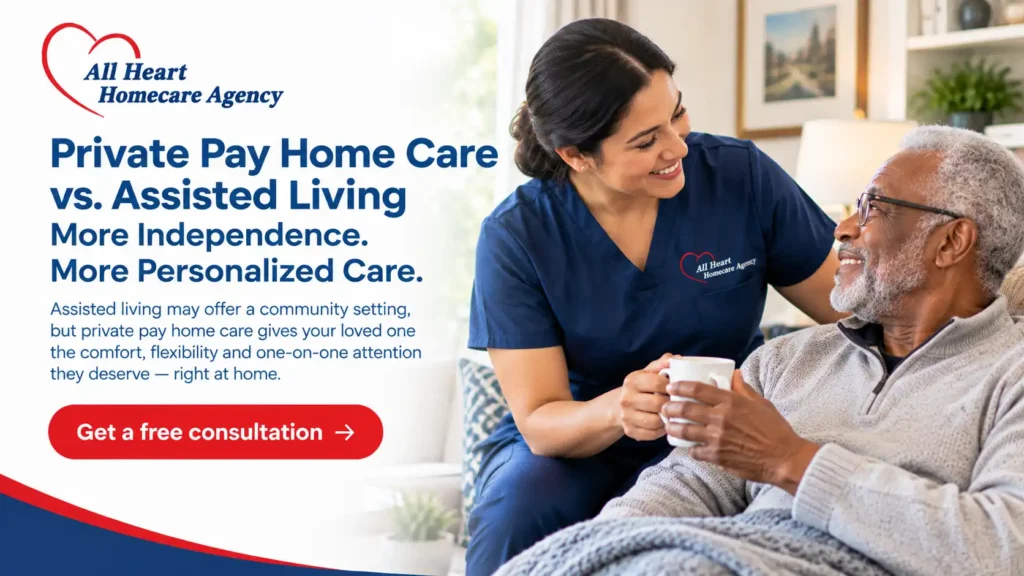
That difference shapes everything else: cost structure, personalization, and quality of life.
What Is Private Pay Home Care?
Private pay home care is one-on-one, non-medical help delivered at home and paid for privately:
- Services: personalized help with activities of daily living; bathing, dressing, meal prep, light housekeeping, mobility, and companionship;
- Cost: billed hourly (averaging about $32–$35/hour nationally), so you pay only for the hours you need;
- Housing: the senior stays in their own home and keeps their existing housing costs; and
- Flexibility: fully customizable, from a few hours a day up to around-the-clock (24-hour) care.
Explore private pay home care and rates.
What Is Assisted Living?
Assisted living is a residential option that combines housing and care:
- Services: room, meals, housekeeping, medication management, and 24/7 on-site staff for safety;
- Cost: a national median of about $5,800–$6,200/month, bundling room, board, and basic care into one predictable fee;
- Housing: included in the monthly fee, eliminating separate utilities, upkeep, and groceries; and
- Social life: built-in community spaces and group activities that can reduce isolation.
Learn more about residential options from the National Institute on Aging.
Cost Comparison: Home Care vs. Assisted Living
Here’s how the numbers compare (national 2026 figures; NYC runs higher):
| Cost factor | Private Pay Home Care | Assisted Living |
| Pricing model | Hourly (~$32–$35/hr) | Flat monthly fee |
| Part-time (44 hrs/wk) | ~$6,600/month | ~$5,800–$6,200/month |
| 24/7 care | $17,000–$18,000+/month | Base fee + care level add-ons |
| Housing | Paid separately by senior | Included in the fee |
| Pay for what you use? | Yes — only the hours you need | No — flat fee regardless |
Which Is More Cost-Effective?
It comes down to hours.
For part-time care: a few hours a day, which is what most seniors need, home care is typically the more affordable option because you pay only for the time used and avoid a full facility fee.
For continuous 24/7 care, the round-the-clock hours can push home care above an assisted living fee, so assisted living may become more cost-effective at that level.
The honest takeaway: if your loved one needs help for part of the day and wants to stay home, home care usually wins on both cost and quality of life.
See our Home Care Costs in 2026: NYC Pricing Guide and The Cost of Home Care: Who Pays and How Much.
Beyond Cost: Why Families Choose Home Care
Cost is only part of the decision. For many families, home care wins on the things money can’t measure:
- Staying home: remaining in familiar, comforting surroundings, which matters enormously for well-being and especially for those with memory loss;
- One-on-one attention: a caregiver focused solely on your loved one, not shared among dozens of residents;
- Personalized routine: their own schedule, food, and habits, not a facility’s timetable; and
- Family closeness: staying near family and community.
See the full picture in the benefits of in-home care for seniors.
When Assisted Living Might Make Sense
In fairness, assisted living can be a good fit in some situations: when a senior is isolated and would thrive on built-in social activity, when the home isn’t safe or maintainable, or when around-the-clock supervision is needed, and 24/7 home care would cost more.
The right choice depends on the person’s needs, finances, and preferences, and it’s worth comparing both honestly before deciding.
Private Pay Home Care vs. Assisted Living: Side-By-Side
A quick summary of the trade-offs:
| Factor | Private Pay Home Care | Assisted Living |
| Setting | Own home | Residential community |
| Attention | One-on-one | Shared among residents |
| Best for | Part-time & staying home | 24/7 needs & social setting |
| Flexibility | Fully customizable hours | Set fee & routines |
| Social life | Family & community-based | Built-in group activities |
| Move required? | No | Yes |
Common Questions: Medicare and Affordability
Two questions families ask most:
- How much will Medicare pay for in-home care? Medicare pays only for short-term skilled home health for homebound patients, not ongoing personal home care or assisted living. See Does Medicare Pay for Home Health Care for Seniors
- What if you can’t afford assisted living? Flexible, part-time home care is often the answer, you pay only for the hours you need. Medicaid, long-term care insurance, and VA benefits can also fund in-home care.
How To Decide
- Assess the hours of care needed. Part-time strongly favors home care; 24/7 is where you compare closely.
- Add up the true costs of each. For home care, include existing housing; for assisted living, add care-level fees.
- Weigh quality of life. Does your loved one want to stay home, and is the home safe and maintainable?
- Consider funding. Private pay, Medicaid, LTC insurance, or VA benefits for home care. See How to Pay for Private Home Care in NYC
Get a professional care assessment. All Heart Homecare will help you compare and choose. Contact us.
The Bottom Line for New York Families
Private pay home care and assisted living both provide real support, but they offer very different lives. Assisted living bundles housing and 24/7 staffing into one fee and suits some families, especially at very high care levels.
For most seniors, though, private pay home care delivers something assisted living can’t: personalized, one-on-one care in the comfort of their own home, often for less at part-time levels. If staying home matters to your loved one, home care is usually the choice families never regret.
Let All Heart Homecare help your loved one stay home for less than assisted living.
Our caregivers serve families across NYC: Brooklyn, Manhattan, the Bronx, Queens, and Staten Island with flexible, one-on-one private-pay home care built around your schedule and budget.
Reach out for a free, no-pressure conversation.
Contact All Heart Homecare Today.
Frequently Asked Questions About Private Pay Home Care vs Assisted Living
Is home care better than assisted living?
For most families who want to stay home, yes. Private pay home care offers one-on-one, personalized help in familiar surroundings and is usually more affordable for part-time care. Assisted living can be more cost-effective for round-the-clock needs, but home care keeps a loved one at home with dedicated attention.
What is the difference between private pay home care and assisted living?
Private pay home care is one-on-one help delivered in the person’s home, billed hourly, with the senior still responsible for housing costs. Assisted living is a residential community that bundles housing, meals, and basic care with 24/7 on-site staff into one monthly fee.
Is private pay home care cheaper than assisted living?
It depends on the hours. For part-time care, home care is usually cheaper because you pay only for the hours you need. Home care averages about $32 to $35 per hour, while assisted living runs a national median of roughly $5,800 to $6,200 per month. At 24/7 hours, assisted living can become the more cost-effective option.
How much is assisted living per month?
Assisted living has a national median of about $5,800 to $6,200 per month, which bundles room, board, and basic care into one predictable fee. Costs are higher in expensive areas like New York City and rise for higher levels of care or memory care.
How much will Medicare pay for in-home care?
Medicare pays only for short-term skilled home health care (nursing or therapy) for homebound patients, not for ongoing personal home care or for assisted living. Private pay home care is funded through private pay, long-term care insurance, or Medicaid for those who qualify.
What happens if you can’t afford assisted living?
Families who can’t afford assisted living often turn to more flexible, part-time private pay home care, which is billed hourly so you pay only for what you need. Medicaid, long-term care insurance, and VA benefits can also help fund in-home care for those who qualify, letting a loved one stay home affordably.
Which is better for someone who wants to stay in their own home?
Private pay home care is the clear choice for someone who wants to remain in their own home. It brings personalized, one-on-one care to them, keeps them in familiar surroundings near family, and lets them keep their routines while scaling from a few hours a day up to 24-hour support.