

Before diving into how to prepare for the NYIA assessment, it’s important to ensure you’re familiar with the basics of the process. If you haven’t already read Part 1, where we explain the NYIA assessment process in detail and provide the necessary steps to get prepared, [click here to read Part 1: NYIA Assessment in New York: What It Is, How It Works, and What to Expect (2026 Guide)].
How to Prepare for an NYIA Assessment
Preparing properly for your NYIA assessment and New York evaluation can significantly improve your chances of approval and reduce unnecessary delays in the NYIA approval process. Because the NYIA eligibility assessment determines whether you qualify for Medicaid long-term home care in NY, being organized and transparent is essential.
The New York Independent Assessor evaluates both medical necessity and daily functional limitations. The more clearly your situation is documented, the smoother the decision process will be.
Before your Community Health Assessment CHA) and clinical assessment NYIA appointment, take the following steps:
- Create a complete medication list.
- Gather diagnoses and hospital discharge paperwork.
- Document daily challenges honestly.
- Be transparent about the assistance needed.
- Include the primary caregiver during assessment.
If you are unsure how to prepare for the NYIA assessment New York requires, speaking with a Medicaid home care advisor beforehand can make the process much smoother. Early guidance helps families avoid common mistakes and approach the evaluation with clarity and confidence. If you are looking to receive home care service with All Heart Homecare Agency, our knowledgeable intake specialists will guide you through the process, prepare you for the assessment, and will answer any of your concerns and questions.
Preparation does not guarantee approval, but it greatly increases the likelihood that your true care needs are accurately documented and properly reviewed.
Common Mistakes Families Make During the NYIA Assessment
Many families encounter problems during the NYIA assessment process in New York, not because their loved one is truly ineligible, but because the assessment fails to capture the full reality of daily care needs. The NYIA eligibility assessment is based on what is observed, explained, and documented during the evaluation, so that small misunderstandings can lead to delays, lower service recommendations, or even denial.
- One of the most common issues is minimizing care needs. Seniors often want to protect their independence and may say they are fine, even when they rely on daily help. Families may also avoid describing difficulties because they do not want their loved one to feel embarrassed. However, the NYIA Medicaid home care process depends on honest detail. If help with bathing, dressing, toileting, transferring, or medication management is not clearly stated, the written record may not reflect true need.
- Another frequent mistake is underreporting fall risks and safety concerns. Falls, near falls, dizziness, poor balance, or confusion at night are critical to the clinical assessment NYHA reviewers use to determine medical necessity. If these safety risks are not mentioned, the evaluation can appear less urgent than it actually is.
- Missing documentation can also weaken the case. When records such as discharge summaries, diagnosis confirmations, medication lists, or recent physician notes are incomplete, the assessor may not have sufficient medical evidence to support eligibility fully. This can slow the NYIA approval process or contribute to denial.
- Families also sometimes attend the assessment without the primary caregiver present. A caregiver often provides the clearest picture of what happens day to day, including how much hands-on support is needed and what safety issues occur when no one is there to help. Without that input, the assessment may miss key details.
- Finally, many people assume the assessor already understands the situation. NYIA does not have a full view of daily challenges unless they are clearly explained. The safest approach is to describe the routine honestly, including what assistance is needed, how often help is required, and what happens when support is not available.
Families often want to protect their loved ones’ dignity. But underreporting challenges can result in denial. Be honest. Be detailed. Be clear.
NYIA vs MLTC: What’s the Difference?
The difference between NYIA and MLTC in New York is simple but important. The NYIA assessment in New York determines whether you are clinically eligible for Medicaid long-term home care in New York. At the same time, a Managed Long Term Care MLTC plan coordinates your services and decides how many care hours you receive. In short, NYIA determines eligibility, and MLTC manages care. Although these two programs work together, they are separate entities with completely different roles.
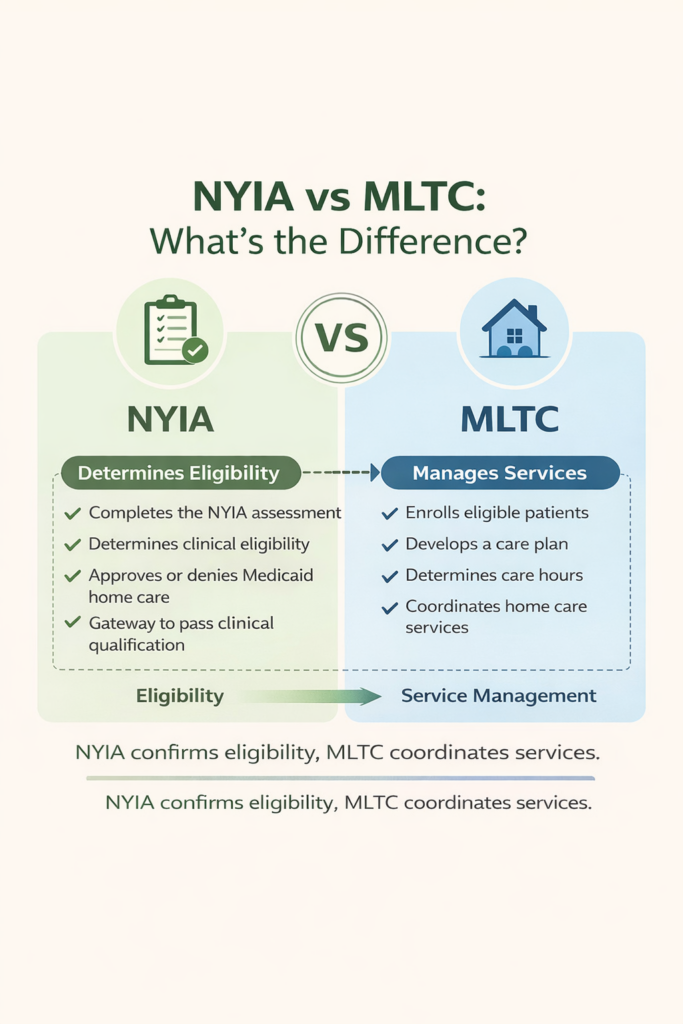
Understanding this distinction prevents confusion during the Medicaid long-term home care process and helps families know who to contact at each stage. If you are still in the assessment phase, your focus is on completing the NYIA assessment required by New York. If you are already approved, your next step is MLTC enrollment in New York and care coordination. Clarity at each stage reduces stress and helps families move through the system more confidently.
The Emotional Side of the NYIA Process
The NYIA assessment that New York families complete is not just an administrative requirement. For many individuals and caregivers, it is an emotional experience tied to vulnerability, uncertainty, and concern about the future. While the NYIA eligibility assessment is designed to evaluate medical necessity for Medicaid long-term home care services, the process can feel deeply personal.
It often brings:
- Fear of denial
- Vulnerability during evaluation
- Overwhelm navigating Medicaid
- Anxiety about future care
For seniors, especially, the Community Health Assessment CHA NY can feel uncomfortable. Being asked detailed questions about bathing, toileting, mobility, memory loss, or fall risk can feel like a loss of independence. Many individuals have spent their lives caring for others. Needing help themselves can be difficult to accept.
Family caregivers experience a different kind of emotional weight. They worry about:
- What will happen if approval is delayed
- How they will manage if services are denied
- Whether they explained daily challenges clearly enough
- Whether the clinical assessment NYIA reviewer understood the full situation
It is common for families to feel as though they are being judged. In reality, the NYIA Medicaid home care evaluation is not about worthiness or character. It is designed to measure functional need and medical necessity in accordance with state guidelines. The assessment is intended to determine eligibility for Medicaid long-term home care services based on documented care needs. It is a structured process, not a personal evaluation.
Still, the emotional impact is real. Waiting for the NYIA approval decision can be stressful, especially when safety concerns exist at home. Uncertainty about MLTC enrollment in New York and future care planning can feel overwhelming. This is why preparation and guidance matter. When families understand the steps, know what to expect, and feel supported through the process, the emotional burden decreases significantly.
Support during this stage can make a meaningful difference both emotionally and practically. Clear information, organized documentation, and reassurance help families move through the NYIA assessment process in New York with greater confidence and less fear.
How All Heart Home Care Supports Families Through the NYIA Process
At All Heart Home Care, we guide families throughout the NYIA process.
We provide:
- Pre-assessment preparation guidance
- Documentation support
- Help me understand approval letters.
- Guidance for selecting MLTC plans.
- Ongoing coordination once services begin
Our goal is not to replace NYIA — but to help families navigate it confidently.
Conclusion
The NYIA assessment process in New York requires preparation, clarity, and emotional readiness. Understanding common mistakes, knowing the difference between NYIA and MLTC, and preparing documentation properly can significantly improve the overall experience. Families who approach the assessment with honesty, organization, and guidance are better positioned to ensure their loved one’s care needs are accurately documented. The more clearly functional limitations and medical necessity are explained, the smoother the process tends to be. Navigating Medicaid long-term home care in New York can feel overwhelming, but informed preparation reduces uncertainty and stress.
Schedule a Free Medicaid Home Care Consultation