

AI in Home Healthcare in 2026: Uses & Best Practices
If you’ve ever worried about an aging parent living alone, you’re not alone. Many families want to help their loved ones stay independent, but they also want reassurance that someone will notice if something changes. That’s one reason AI is becoming more common in home healthcare. Rather than replacing caregivers, these tools help care teams stay informed, respond faster, and provide an extra layer of support between visits.
The importance of AI in healthcare continues to grow. According to McKinsey, broader adoption of AI technologies could generate between $200 billion and $360 billion in annual value across the healthcare industry through improved efficiency, better decision-making, and enhanced patient outcomes.
The growing adoption of AI in home care comes as demand for home-based services continues to rise. According to AARP, most older adults prefer to remain in their homes as they age rather than move into institutional care settings. At the same time, healthcare providers face increasing pressure to deliver high-quality care while managing staffing shortages and rising healthcare costs.
This is where AI for home health care can make a meaningful difference. By analyzing data, recognizing patterns, and providing timely alerts, AI helps care teams focus more on patient care and less on repetitive administrative tasks.
Key Takeaways
- Home health AI helps improve patient monitoring, medication management, communication, and care coordination.
- Artificial intelligence can identify potential health concerns earlier through predictive analytics and real-time monitoring.
- AI supports caregivers by reducing administrative tasks and improving documentation accuracy.
- Successful implementation requires strong privacy protections, staff training, and human oversight.
- AI enhances care delivery but does not replace the compassion and expertise of professional caregivers.
- Emerging technologies such as remote patient monitoring, voice assistants, and predictive health analytics are expected to play a larger role in home healthcare throughout 2026 and beyond.
What Is AI in Home Healthcare?
Artificial intelligence (AI) in home healthcare refers to the use of advanced software, algorithms, and connected technologies that help support patient care in a home setting.
Rather than simply collecting information, AI systems analyze data, recognize patterns, and provide actionable insights that help caregivers, healthcare providers, and families make informed decisions.
Think of AI as a highly intelligent assistant that continuously monitors information and helps identify potential concerns before they become serious problems.
For example, AI-powered systems can:
- Track changes in activity levels
- Monitor vital signs remotely.
- Identify missed medications
- Detect potential fall risks.
- Improve communication between care teams.
- Predict health changes before symptoms worsen.
Unlike traditional monitoring systems that only collect data, artificial intelligence in home care actively interprets information and provides recommendations based on patterns and trends.
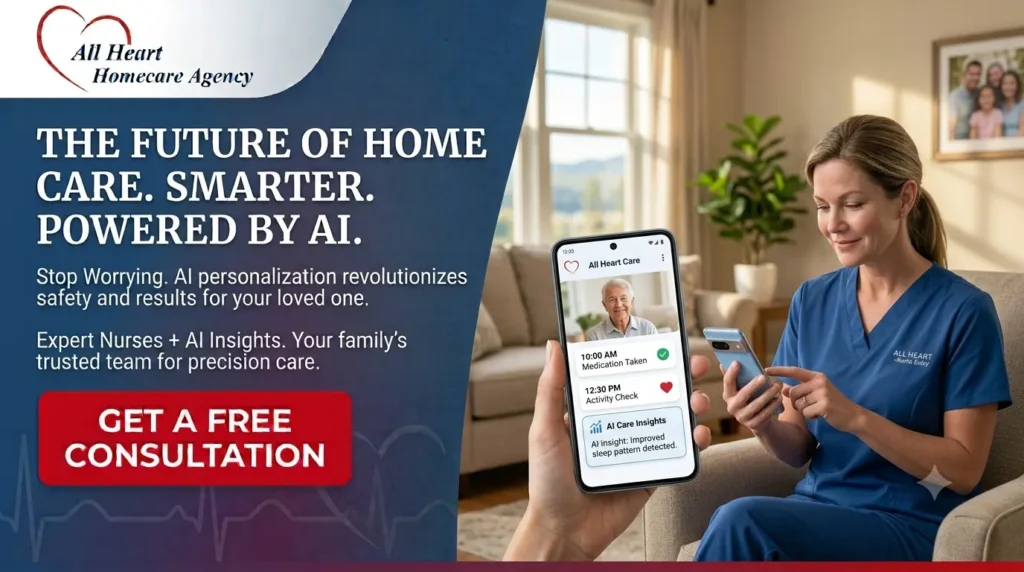
Why AI Matters in Home Healthcare
The demand for home-based care continues to rise as more older adults choose to age in place. AARP research found that 77% of adults aged 50 and older want to remain in their homes as they age, creating a growing need for technologies that support safe and independent living.
The healthcare industry is experiencing significant changes driven by an aging population and increasing demand for home-based care services.
According to the U.S. Department of Health and Human Services, nearly 70% of adults age 65 and older will require some form of long-term care during their lifetimes. As more families choose home-based care solutions, healthcare providers are seeking innovative ways to improve outcomes while maintaining high-quality, personalized care.
AI helps address several common challenges in modern home healthcare. Many providers offering Home Health Care Services are using AI-powered tools to improve patient monitoring, reduce hospital readmissions, support medication adherence, and enhance caregiver efficiency.
- Monitoring patients between visits
- Reducing hospital readmissions
- Supporting medication adherence
- Improving caregiver efficiency
- Enhancing family communication
- Identifying health risks earlier
These capabilities can help patients remain safely at home longer while giving families greater peace of mind.
5 Common Technologies Used in Home Health AI
Several types of AI-powered technologies are currently being used in home healthcare environments:
1. Remote Patient Monitoring Systems
Wearable devices and smart sensors collect information about a patient’s health and daily activities. AI analyzes this information and alerts caregivers to unusual changes.
2. Smart Medication Management Tools
AI-powered medication systems help patients remember when to take medications and notify caregivers if doses are missed.
3. Predictive Analytics Platforms
These systems analyze health trends and identify potential risks before serious complications occur.
4. Virtual Health Assistants
Voice-enabled AI assistants can help patients manage appointments, answer basic health questions, and provide medication and daily task reminders.
5. Care Coordination Software
AI-powered platforms improve communication between caregivers, nurses, physicians, patients, and family members.
Benefits for Patients and Families
When implemented responsibly, home health AI can provide significant benefits:
- Faster identification of health concerns
- Improved medication compliance
- Better communication with care teams
- Increased patient safety
- More personalized care plans
- Reduced caregiver stress
- Greater peace of mind for families
For home healthcare agencies, AI can also improve scheduling, documentation, and resource management, allowing caregivers to spend more time focusing on patient care.
As AI technologies continue to evolve, their role in supporting safe, efficient, and compassionate home healthcare is expected to grow significantly throughout 2026 and beyond.
5 AI Uses in Home Care Environments
Artificial intelligence is no longer a futuristic concept in healthcare. Today, AI in home care is helping agencies, caregivers, and families improve patient outcomes while making care delivery more efficient and responsive.
From remote monitoring systems to predictive analytics, AI technologies are transforming how healthcare professionals support patients in their homes.
Below are five of the most impactful ways home care AI is being used in home healthcare environments in 2026.
AI for Patient Monitoring
One of the most valuable applications of AI for home health care is remote patient monitoring.
Traditionally, healthcare providers only had visibility into a patient’s condition during scheduled visits. However, health issues can develop between appointments, making early intervention difficult.
Imagine a senior who usually walks around the neighborhood every morning. Over the course of a week, their activity level drops, they begin sleeping more, and they miss a medication reminder. Individually, these changes may not seem serious. Together, however, they can signal that something is wrong. AI-powered monitoring systems help identify these patterns early so caregivers can check in before a small issue becomes a larger health concern. These tools are especially valuable for patients receiving Skilled Nursing Care, where continuous monitoring can help caregivers identify health concerns between visits.
These systems may use:
- Wearable health devices
- Smart watches
- Motion sensors
- Bed sensors
- Blood pressure monitors
- Pulse oximeters
- Fall detection technology
The collected data is analyzed continuously by AI algorithms that look for unusual changes or warning signs. Research published by the National Institutes of Health (NIH) suggests that AI-assisted remote monitoring can help identify health changes earlier and support proactive interventions, particularly for older adults managing chronic conditions.
For example, AI may detect:
- Reduced physical activity
- Increased fall risk
- Changes in sleep patterns
- Elevated heart rate
- Abnormal blood pressure readings
- Respiratory concerns
Rather than requiring caregivers to manually review large amounts of data, AI automatically highlights potential issues and sends alerts when intervention may be needed.
Benefits of AI-Powered Monitoring
- Earlier identification of health concerns
- Improved chronic disease management
- Reduced emergency room visits
- Faster response times
- Greater peace of mind for families
For seniors aging in place, these monitoring tools provide an additional layer of safety without disrupting daily routines.
AI for Medication Management
Medication adherence remains one of the biggest challenges in home healthcare. For patients receiving Adult Private Duty Nursing, AI-powered medication management tools can improve compliance and reduce medication-related complications.
According to research published by the National Institutes of Health, medication non-adherence contributes to thousands of preventable hospitalizations each year.
Older adults often manage multiple prescriptions, increasing the risk of:
- Missed doses
- Incorrect dosages
- Drug interactions
- Medication duplication
AI-powered medication management systems help reduce these risks.
These systems can:
- Provide medication reminders
- Track compliance
- Alert caregivers to missed doses
- Identify potential medication conflicts.
- Generate adherence reports
Some advanced medication platforms even use smart dispensers that automatically release medications at scheduled times.
If a dose is missed, caregivers or family members can receive immediate notifications.
Benefits of AI Medication Management
- Improved medication compliance
- Reduced medication errors
- Better chronic disease control
- Enhanced family oversight
- Fewer avoidable hospitalizations
For patients managing diabetes, heart disease, dementia, or multiple chronic conditions, medication management is one of the most practical applications of artificial intelligence in home care.
AI for Predictive Health Analytics
Predictive analytics is one of the fastest-growing areas of healthcare AI because it helps providers move from reactive treatment to proactive care management. Healthcare leaders increasingly view predictive AI as a key tool for improving patient outcomes and operational efficiency.
Perhaps the most exciting advancement in home health AI is predictive analytics.
Predictive analytics uses machine learning algorithms to analyze health data and identify patterns that may indicate future health concerns.
Instead of reacting to problems after they occur, healthcare providers can take preventive action.
AI systems evaluate data from multiple sources, including:
- Vital signs
- Activity levels
- Sleep quality
- Medication adherence
- Medical history
- Caregiver observations
By combining these data points, AI can identify subtle warning signs that humans might overlook.
For example, predictive analytics may detect:
- Increased risk of hospitalization
- Early signs of infection
- Worsening heart failure
- Fall risk escalation
- Declining mobility
- Cognitive changes
This proactive approach allows care teams to intervene before conditions become serious. Organizations providing Private Duty Nursing services are increasingly using predictive analytics to support proactive care planning and reduce avoidable hospitalizations.
Benefits of Predictive Analytics
- Earlier treatment interventions
- Reduced hospital readmissions
- Better chronic disease management
- Improved patient outcomes
- More personalized care planning
For home healthcare agencies, predictive analytics supports a shift from reactive care to preventive care.
AI for Communication
Communication is essential in home healthcare.
Patients, caregivers, family members, nurses, physicians, and therapists all need access to accurate and timely information.
AI-powered communication tools help improve coordination and reduce communication gaps.
Modern systems can provide:
- Real-time care updates
- Automated visit summaries
- Secure messaging
- Appointment reminders
- Language translation support
- Family notifications
These tools help ensure everyone involved in care remains informed.
For example, a family member living in another state can receive updates about:
- Caregiver visits
- Medication compliance
- Health concerns
- Changes in condition
- Upcoming appointments
This transparency helps families remain engaged even when they cannot be physically present.
Benefits of AI Communication Tools
- Improved care coordination
- Better family engagement
- Faster information sharing
- Reduced administrative burden
- Increased patient satisfaction
As healthcare becomes increasingly collaborative, communication technologies are becoming an essential component of successful home care programs.
AI for Administrative Support
While patient-facing technologies receive the most attention, administrative AI tools are also transforming home healthcare operations.
Caregivers often spend significant time completing documentation, updating records, and managing schedules.
AI helps automate many of these tasks.
Common administrative applications include:
- Scheduling optimization
- Visit documentation
- Electronic health record support
- Billing assistance
- Staff allocation
- Route planning
- Quality assurance reporting
By reducing administrative workload, caregivers can focus more on direct patient care.
This not only improves efficiency but also enhances the patient experience.
Benefits of Administrative AI
- Reduced paperwork
- Improved documentation accuracy
- Better caregiver productivity
- Lower operational costs
- More time spent with patients
Healthcare organizations that effectively implement administrative AI often experience improvements in both staff satisfaction and operational performance.
How AI Applications Support Home Healthcare
The following table summarizes the most common applications of AI in home healthcare and their benefits.
| AI Application | Primary Function | Patient Benefit | Caregiver Benefit |
| Remote Patient Monitoring | Tracks health metrics and daily activities | Earlier detection of health concerns | Faster intervention and oversight |
| Medication Management | Improves medication adherence | Reduced medication errors | Better compliance tracking |
| Predictive Analytics | Identifies future health risks | Preventive care opportunities | More proactive care planning |
| Communication Platforms | Enhances information sharing | Better family engagement | Improved care coordination |
| Administrative Automation | Reduces manual tasks | More caregiver attention | Greater efficiency and accuracy |
These applications demonstrate why AI for home health care is becoming an increasingly important tool for improving safety, efficiency, and patient outcomes.
However, technology alone cannot deliver exceptional care. The true value of AI lies in its ability to support caregivers and empower them to focus on what matters most—providing compassionate, personalized care to every patient.
AI for Empowering Caregivers
While much of the conversation around AI focuses on patient care, one of its most significant benefits is its support for caregivers.
Home healthcare professionals often balance multiple responsibilities, including patient visits, documentation, scheduling, communication with families, and care coordination. AI tools help reduce administrative burdens, allowing caregivers to spend more time delivering quality care. Many agencies providing elderly home care services in NYC are beginning to adopt AI-powered solutions to improve caregiver efficiency and patient outcomes.
For example, AI-powered documentation systems can automatically generate visit summaries, organize patient notes, and update care records. Instead of spending hours completing paperwork, caregivers can focus on patient interaction and personalized support.
AI also improves caregiver scheduling by:
- Matching caregivers with patients based on skills and preferences
- Optimizing travel routes
- Reducing scheduling conflicts
- Identifying staffing gaps before they become problems
For agencies providing services such as Private Duty Nursing, Skilled Nursing Care, and Home Health Care Services, these efficiencies help improve both patient outcomes and caregiver satisfaction.
Most importantly, AI provides caregivers with actionable insights that support better decision-making. Rather than replacing human expertise, AI acts as an intelligent support system that helps caregivers recognize risks, prioritize tasks, and deliver more responsive care.
Best Practices for AI in Home Healthcare
Organizations implementing AI in home healthcare should follow several best practices to maximize benefits while maintaining patient trust and safety.
- Use AI to support and not replace human caregivers.
- Ensure all AI tools comply with HIPAA and privacy regulations.
- Train staff on proper AI usage and interpretation
- Regularly evaluate the AI system’s performance.
- Maintain human oversight for important clinical decisions.
- Clearly communicate AI usage to patients and families.
- Use secure, encrypted systems for data storage and sharing.
- Continuously update AI tools to reflect current healthcare standards.
- Monitor for bias or inaccuracies in AI recommendations.
- Focus on patient-centered care at every stage of implementation.
Successful AI adoption depends on balancing technological innovation with compassionate, human-centered care.
Implementation of AI in Home Health Environments
Implementing AI successfully requires a structured approach.
The following step-by-step process can help home healthcare agencies effectively integrate AI technologies.
Step 1: Identify Care Challenges
Start by identifying areas where AI can provide the greatest value.
Common challenges include:
- Medication adherence
- Patient monitoring
- Documentation workloads
- Care coordination
- Scheduling inefficiencies
Clearly defining goals helps organizations select the right technologies.
Step 2: Evaluate Available Solutions
Research AI platforms that align with organizational needs.
Consider:
- Security features
- Ease of use
- Integration capabilities
- Vendor support
- Cost
- Scalability
Healthcare organizations should prioritize platforms designed specifically for home healthcare environments.
Step 3: Train Care Teams
Proper training is critical.
Caregivers should understand:
- How AI tools work
- What information do they provide
- How to interpret recommendations
- When human judgment should override automated suggestions
Training promotes confidence and encourages adoption.
Step 4: Launch a Pilot Program
Before organization-wide implementation, test AI systems with a smaller patient group.
Pilot programs help identify:
- Workflow challenges
- Technical issues
- Staff concerns
- Patient feedback
This approach reduces implementation risks.
Step 5: Measure Outcomes
Monitor key performance indicators such as:
- Hospital readmissions
- Medication adherence
- Caregiver productivity
- Patient satisfaction
- Response times
Data-driven evaluation helps determine whether AI tools are delivering measurable benefits.
Step 6: Expand and Optimize
After successful testing, organizations can gradually expand AI usage while continuing to monitor performance and improve workflows.
AI Safety, Privacy, and Human Touch in Home Care
As AI adoption increases, families naturally have questions about safety, privacy, and the role of human caregivers.
These concerns are important and should be addressed transparently.
Privacy and Data Security in Home Care
Healthcare data is among the most sensitive information that individuals share.
AI systems used in home healthcare must comply with strict privacy regulations, including HIPAA requirements.
Modern AI platforms typically include:
- Data encryption
- Secure cloud storage
- Multi-factor authentication
- Access controls
- Audit tracking
- Regular security updates
Healthcare organizations should also establish clear policies regarding:
- Data collection
- Consent
- Information sharing
- Data retention
Families deserve to understand how their information is used and protected. Strong privacy protections are particularly important for individuals receiving specialized services, such as in-home dementia care, where sensitive health information may be shared among care teams and family members.
When implemented properly, AI can improve care without compromising privacy.
The Human Touch: AI Enhances, Never Replaces Compassion
One of the most common misconceptions about artificial intelligence is that it will replace caregivers.
In reality, AI performs best when supporting human care—not replacing it.
Technology can:
- Analyze data
- Detect patterns
- Generate reminders
- Improve communication
But it cannot replace:
- Compassion
- Empathy
- Human connection
- Emotional support
- Relationship building
Patients often value the personal relationships they develop with caregivers.
The comfort of a familiar face, a reassuring conversation, or emotional encouragement cannot be replicated by technology.
The future of home healthcare is not AI versus caregivers.
It is AI working alongside caregivers to deliver better outcomes and a more personalized care experience.
Cost Considerations: Making AI Accessible
Many families worry that advanced technologies will increase healthcare costs.
However, AI can often help reduce expenses over time.
Potential cost-saving benefits include:
- Fewer emergency room visits
- Reduced hospital readmissions
- Improved medication adherence
- Earlier interventions
- Better care coordination
Many remote patient monitoring services and telehealth programs may also qualify for reimbursement through Medicare, Medicaid, or private insurance plans, depending on eligibility and coverage requirements.
As adoption increases, AI-powered tools are expected to become more affordable and accessible for both providers and patients.
The Future of AI-Enhanced Care for 2026
The role of artificial intelligence in home healthcare continues to expand rapidly.
Healthcare leaders increasingly recognize AI as a valuable tool for improving efficiency, reducing costs, and enhancing patient outcomes.
According to McKinsey research, AI technologies could generate between $200 billion and $360 billion in annual value across the healthcare industry through improved efficiency and better clinical decision-making.
At the same time, studies from the National Institutes of Health continue to demonstrate the effectiveness of AI-assisted remote monitoring and predictive analytics for managing chronic conditions and supporting aging populations.
Several trends are expected to shape home healthcare throughout 2026 and beyond.
Emerging Technologies on the Horizon for Home Care Agencies
AI-Powered Fall Detection
Advanced sensor technologies are becoming increasingly effective at identifying fall risks and automatically alerting caregivers.
Voice Assistants for Seniors
Voice-enabled AI systems are evolving beyond simple reminders.
Future systems may help seniors:
- Manage appointments
- Communicate with caregivers
- Access health information
- Monitor daily routines
Predictive Hospitalization Risk Models
AI systems are becoming better at identifying patients who may require hospitalization before serious symptoms develop.
This proactive approach can improve outcomes and reduce healthcare costs.
Generative AI for Documentation
Healthcare providers are increasingly using generative AI tools to automate documentation and reduce administrative workloads.
This allows clinicians and caregivers to focus more time on patient care.
Smart Home Integration
Connected devices are creating safer home environments through:
- Fall detection
- Environmental monitoring
- Emergency alerts
- Medication reminders
These technologies support aging in place while improving independence and safety.
As these innovations continue to mature, AI will play an even greater role in helping individuals receive high-quality care in the comfort of their homes.
Conclusion
Artificial intelligence is transforming home healthcare by helping caregivers, healthcare providers, and families deliver safer, more proactive, and more personalized care.
From remote patient monitoring and medication management to predictive analytics and caregiver support, home health AI offers practical solutions to many of the challenges facing modern healthcare.
However, the most successful approach combines technology with compassionate human care. AI can provide valuable insights and improve efficiency, but empathy, trust, and personal relationships remain at the heart of exceptional home healthcare.
Families evaluating technology-enabled care solutions should also consider working with a trusted provider. Our guide to choosing the best home health agency in the Bronx can help families better understand what to look for when selecting home healthcare services.
As technology continues to evolve throughout 2026 and beyond, organizations that embrace responsible AI adoption will be better positioned to support patients, empower caregivers, and improve health outcomes while preserving the human touch that makes home care so meaningful.
Frequently Asked Questions About AI in Home Care
How do you use AI in care planning and day-to-day support?
AI helps analyze health information, identify trends, monitor daily routines, and provide recommendations that support personalized care planning. Care teams use these insights to improve decision-making and patient outcomes.
How does AI help with caregiver matching, scheduling, or backup coverage?
AI can evaluate caregiver skills, availability, location, and patient needs to improve scheduling and caregiver matching. It can also identify staffing gaps and recommend backup coverage when necessary.
Which parts of the care are reviewed by a human, and which are automated?
Clinical decisions, patient assessments, and care planning remain under human supervision. AI typically assists with monitoring, documentation, reminders, scheduling, and data analysis.
How do you protect my parents’ privacy, health data, and consent when using AI?
Healthcare organizations use secure systems that comply with HIPAA regulations. Data encryption, access controls, consent processes, and security monitoring help protect sensitive information.
How does AI improve safety, communication, and response to changes in my parents’ condition?
AI continuously monitors health information and can identify unusual patterns that may indicate emerging health concerns. Automated alerts and communication tools help caregivers and families respond more quickly to changes.